|
Ghost Sonata
Incidental Music to the Strindberg Play
Composer Facsimile Edition
|
"A beautiful complement to the production is the original music, created by Anna Larson and played by Larson and Tomas Ohrstrum. The music, from an 'orchestra' of non-traditional instruments — wooden wind chimes, a small harp, flutes — punctuates the characters' speeches, and helps indicate Strindberg's intent."
|
|
Alexandria Gazette Packet
|
 |
Among Larson's theater projects are two with Joe Martin including incidental music for a stylized production of Strindberg's Ghost Sonata in 1988 at American Showcase theater (published by I.E. Clark).
The titles of the components are: Notes, Sun Song, Tango, Funeral March, Sun Song Trio, and Benediction.
THE GHOST SONATA: Instruments Used
In order of first use:
1. Rubbed "bell", actually a solid nickle and silver fruit cup rubbed slowly around the rim with a smooth wooden stick to create a steady drone: this is the first sound heard at the beginning of the play; also used in Act II when the Mummy rings the servent's bell for the second time, continuing through Bengtsson's speech (with harmonium); also used in Act III beginning just after the line "It's deaf and dumb", soon joined by a second rubbed bell (see below) during the daughter's death scene, with both bells continuing until the moment when Bengtsson places the death screen in front of the daughter and the cast freezes motionless for the duration of the student's speech.
2. Swedish Christmas bell (bronze, 2" diam.): for church bell, opening tableau.
3. Hanging gong (made from a heavy aluminun 6" pot): for large church bell in opening tableau and funeral bell at end of march; also struck once just before the student sings the Sun Song.
4. Clarinet mouthpiece (alto) attached to a 3' plexiglass tube: for distant boat horn in opening tableau.
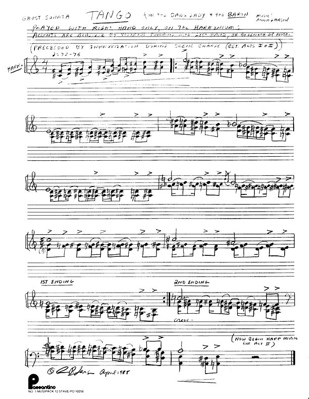
5. Harmonium, a small (2.5 octaves) nasal organ from India played with one hand and pumped with the other: used for "low notes of an organ" in opening tableau; for the tango, preceeded by a scene change improv.; for the improv. under Bengtsson's Act II speech "I know him and he, me"; and for the discordant interjection to the women's trio at the very end of the play).
6. Wind chimes made of thin, flat 2" shells: touched delicately each time the milkmaid dips her hands into the well (in Act I); dropped on the Dumbec drum surface and then shaken violently during the commotion at the end of Act I; also part of the cook's sound (with drum) in Act II.
7. Flute (orchestral): for improv. under the students Act I "rescue" speech; for improv. at the beginning of Act III prior to the funeral march; and for improv. during the student's Act III speech about his father.
8. Small Xylophone: for daughter's first two entrances (high note improv) and for the solo version of "Welcome, Pale".
9. Jaw harp: used for ominous effect in Act I beginning with the student's
"It's beyond belief" until "you're freezing me!"; also in Act II as Hummel enters unseen.
10. Very small wind chimes, made of tiny shells, combines with zylophone
for daughter's first two entrances in Act I and is used alone when she enters to drop her bracelet.
11. Tiny pellet drum (3") tapped lightly with the fingers (as a trill): for he dead man, Act I (with scraped cymbol).
To see score samples, scroll down:
|
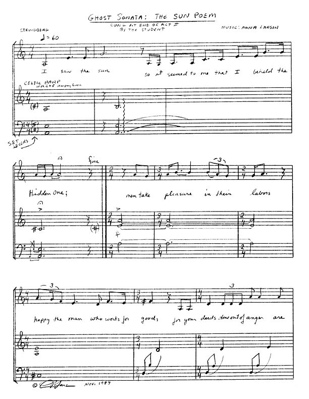
The Sun Poem, ending Act II
|
Tango
|
 |
 |
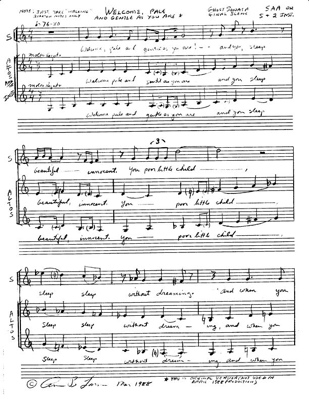
Welcome, Pale And Gentle As You Are from the final scene